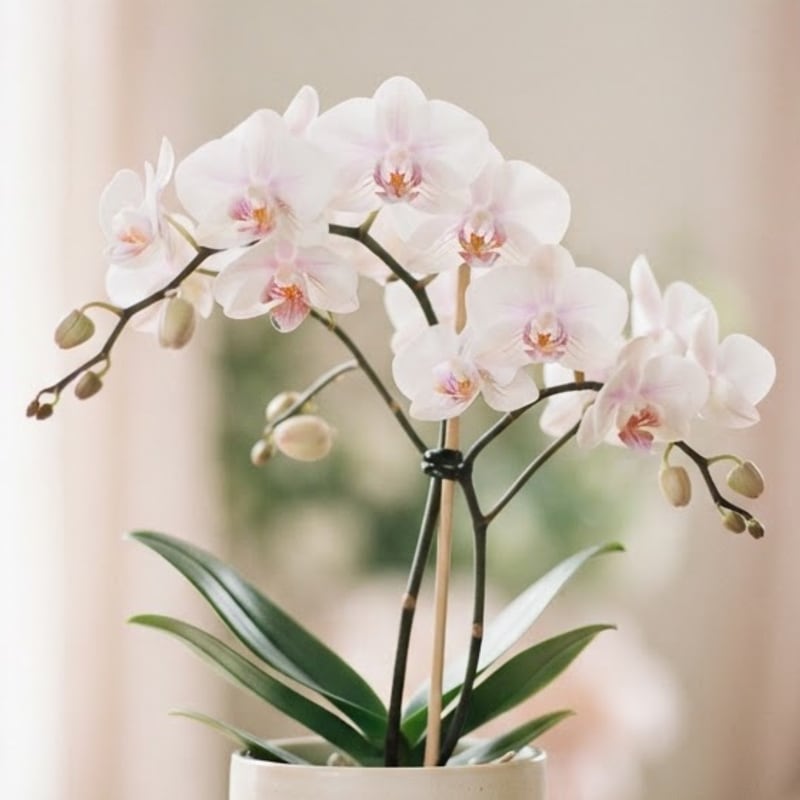
Orchid bark drains fast and lets air reach the roots, while sphagnum moss holds water for days. Bark is the safer choice for most phalaenopsis in most homes. Moss works well when you are careful with watering or your air is very dry.
Orchids in the wild mostly cling to trees. Their roots are used to rain, then wind, then drying out. A pot mix should copy that, and the two materials do it in opposite ways.
What orchid bark does
Bark for orchids is usually fir or pine, sold in chunks about 1 to 2 cm across for a standard phalaenopsis. The gaps between the chunks hold air. Water runs through quickly, which is what most orchid roots want.
Good points
- Roots dry between waterings, which cuts the risk of rot.
- It is hard to overwater by accident.
- It stays open and airy for a year or two.
Drawbacks
- It dries out quickly in a very dry house. Winter heating in Canada can do that.
- Fresh bark repels water until it has been soaked.
- It breaks down over time into smaller, soggier pieces. When that happens, it is time to repot.
What sphagnum moss does
Sphagnum moss is a pale, stringy moss that soaks up many times its own weight in water and releases it slowly. Orchid growers use long-fibre moss, not the fine peat moss from a garden bale.
Good points
- Keeps roots evenly damp, so you can water less often.
- Works well for small pots, seedlings, and orchids with fine roots.
- Helpful if you travel or tend to forget.
Drawbacks
- Easy to overwater. Packed moss stays wet for a long time, and wet roots with no air will rot.
- It compacts as it ages and holds less air each month.
- You can’t judge dryness by looking at the surface, because the top dries while the middle stays soaked.
Side by side
| Bark | Sphagnum moss | |
|---|---|---|
| Water held | Little | A lot |
| Air around roots | Plenty | Less, and it drops as moss packs down |
| Watering rhythm | About once a week, depending on the room | About every 10 to 14 days, depending on the room |
| Main risk | Drying out too fast | Staying wet too long |
| Lifespan | 1 to 2 years | About 1 year |
| Best for | Overwaterers, most phalaenopsis | Underwaterers, dry rooms, small pots |
The watering rhythms are rough guides. Pot size, light, and how warm the room is change them a lot, so check the pot, not the calendar. If you are unsure whether the plant is getting too much or too little, our post on overwatering vs underwatering shows the signs.
Which one to choose
Ask how you actually water.
- You water often and worry about rot. Use bark.
- You forget the plant for a week or two. Use a bark mix with some moss, or moss alone in a clear pot where you can see the roots.
- Your orchid has thin, fine roots or came bare-root. A little moss around the roots helps them settle in.
- You are growing mounted or mesh-basket orchids. Bark is the usual choice because roots need lots of air.
A plain phalaenopsis in a clear plastic pot will be fine in bark. Most of the orchids sold in grocery stores come packed in moss, and many do well for a while. The trouble starts when the moss breaks down and the owner keeps watering on the same schedule.
A pot mix that uses both ideas
Many orchid mixes are built on bark but add other materials to balance water and air. Perlite adds airy spaces and stays light. Horticultural charcoal keeps a mix from going stale. Coco chips hold a bit of moisture without packing down. That is how our Orchid Mix is put together: fir bark, perlite, horticultural charcoal, and coco chips. It is a bark-based mix that holds a little more water than plain bark.
If you prefer to buy bark and moss separately and blend them, a rough start is mostly bark with a handful of moss tucked around the roots. Adjust from there after a couple of waterings. Fertilizer is a separate matter. Neither bark nor moss feeds the plant, so use a diluted orchid fertilizer on a regular schedule.
How to repot into bark
The steps are in our orchid repotting guide, but the short version is:
- Soak the bark in water for several hours or overnight. Drain it.
- Slide the orchid out and shake off the old mix. Cut away roots that are brown, mushy, or hollow. Healthy roots are firm and silver-green or green.
- Place the plant in a clear pot just big enough for the roots. A pot that is too large stays wet too long. Best pots for orchids covers sizes and types.
- Work the bark around the roots, tapping the pot so the pieces settle. Do not press hard.
- Wait about a week before watering thoroughly. Light misting is fine in the meantime.
The best time to repot is after flowering, as covered in what to do after your orchid blooms.
How to repot into moss
Soak the moss, then squeeze it out until it feels like a wrung sponge, damp but not dripping. Wrap it loosely around the roots and place the plant in a pot with drainage holes. Press lightly. If you can squeeze water out of the pot with your hand, it is too wet.
Water again only when the centre of the moss feels barely damp. A wooden skewer pushed to the bottom helps: if it comes out dark and wet, wait.
Signs the mix is wrong
- Roots are brown and soft, and the mix smells sour. Too wet. Repot into fresher, chunkier material.
- Roots look grey and shrivelled, and leaves are limp. Too dry. Water more often, or add some moss.
- Mix has turned fine and crumbly. It has broken down. Repot.
Whichever you pick, the pot needs drainage holes, and the plant should never sit in a saucer of water. Bark and moss are both fine. What fails orchids is a mix that no longer matches how the plant is watered.