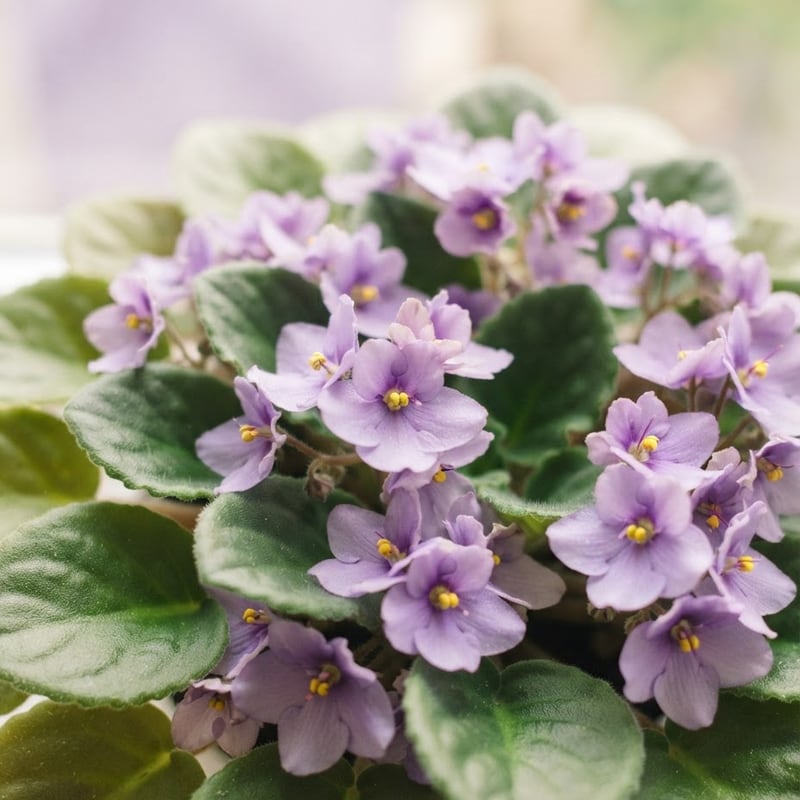
The best soil for African violets is light and fluffy, holds some moisture, and drains easily. A mix built on peat moss with perlite and vermiculite does that. Heavy all-purpose potting soil usually stays too wet for their fine roots.
African violets (Saintpaulia) have shallow roots that sit near the top of the pot. They want even moisture but not soggy soil, and they want air around the roots. The mix has to give them both.
What the roots need
Three things, in this order:
- Air. Roots breathe. A mix packed tight leaves them gasping, and rot follows.
- Light moisture. The mix should stay slightly damp between waterings, not dry out in a day and not stay wet for a week.
- Mild acidity. African violets are comfortable around pH 6.0 to 7.0. Peat-based mixes tend to land there.
Nutrients are a separate question. Soil alone doesn’t supply them, and no mix of ours contains fertilizer, so plan to use a fertilizer made for African violets, diluted and applied on a regular schedule.
The usual ingredients
Sphagnum peat moss
Peat is the base of most African violet mixes. It holds water, stays light, and is naturally acidic. It is the reason a good violet mix feels spongy rather than muddy. Coco coir is a common substitute and behaves in a similar way.
Perlite
Perlite is the small white volcanic glass pebbles you see in many mixes. It holds almost no water, but it creates air gaps. It is what keeps peat from clumping.
Vermiculite
Vermiculite is a mineral that looks like tiny golden-brown flakes. It holds some water and releases it slowly, which is useful for roots that dislike drying out. If you want to know which of the two does what, our post on perlite vs vermiculite goes through it.
A simple, workable blend is mostly peat with a good amount of perlite and some vermiculite. The exact proportions vary from grower to grower, and there’s no single correct ratio. The test is how it feels: spongy, loose, and not dusty.
Our African Violet Mix is built on this idea, with sphagnum peat, perlite, and vermiculite. It also suits streptocarpus and gloxinia, which have similar needs.
What to avoid
- Garden soil or topsoil. Too heavy, and it may bring pests.
- Dense all-purpose potting mixes. They are fine for tough plants. For violets they tend to pack down and stay soggy. If it’s all you have, mix in roughly one part perlite to two parts soil and see how it behaves.
- Mixes with large bark chunks. Great for orchids, wrong for violets.
- Old, crusty mix. Over time the peat breaks down, the mix gets compact, and salts from tap water and fertilizer build up as a white crust.
When regular potting soil is fine
If you have a bag of general-purpose potting mix, you can make it work. Loosen it with perlite, use a pot with a drainage hole, and watch the watering. Many people grow violets this way for years. The risk is overwatering, because dense soil dries slowly. See potting soil vs potting mix if you aren’t sure what the bag in your hand is.
The pot matters as much as the soil
African violets bloom best when slightly root-bound. A common rule is a pot about one third the width of the plant’s leaf spread. For a violet 20 cm across, that’s a pot of about 7 cm. A bigger pot holds more wet soil than the roots can use.
Use a pot with a drainage hole. Some growers like a self-watering pot or a wicking setup, which can work well, but the mix still needs to be airy.
Repotting
Repot about once a year, or sooner if the mix has sunk, the plant has grown a long, bare neck, or roots are circling the pot.
- Water the plant lightly a day before so the root ball slips out easily.
- Remove the plant, shake off the old mix, and trim any dark, mushy roots.
- If the plant has a bare neck (a stem with lower leaves removed), you can bury it a little deeper. New roots will form along the stem.
- Fill the pot with fresh, slightly damp mix. Do not press firmly.
- Water lightly, let it drain, and leave the plant in bright, indirect light.
For tips on light, watering, and getting more blooms, our African violet care guide covers the full routine. If the plant looks poor after repotting, signs your plant needs repotting will help you tell what’s wrong.
Watering tips that protect the soil
- Use room-temperature water. Cold water can leave marks on leaves and shock roots.
- Water from the bottom or pour carefully around the edge. Droplets sitting on the leaves can leave spots.
- Wait until the top of the mix feels dry to the touch, then water. Let excess drain away.
- Empty the saucer after about 15 to 20 minutes.
Dry indoor air from winter heating can make this harder in Canada. The mix will dry faster, so check more often rather than watering on a fixed schedule. More on that in winter houseplant care in Canada.
Signs the soil isn’t right
- Soil is soggy for days, leaves are limp. Too dense or too much water. Repot into lighter mix.
- Mix pulls away from the pot edge and water runs straight through. Too dry or too old. Water from the bottom and consider repotting.
- White crust on the surface or rim. Salt build-up. Scrape it off and flush the pot with plain water, or repot.
- Growth is slow and blooms are few. Many causes, but old, compacted soil is a common one.
Short version
Use a light, peat-based mix with perlite and vermiculite, a small pot with a drainage hole, and fresh soil about once a year. Keep the plant evenly damp, never soggy.